
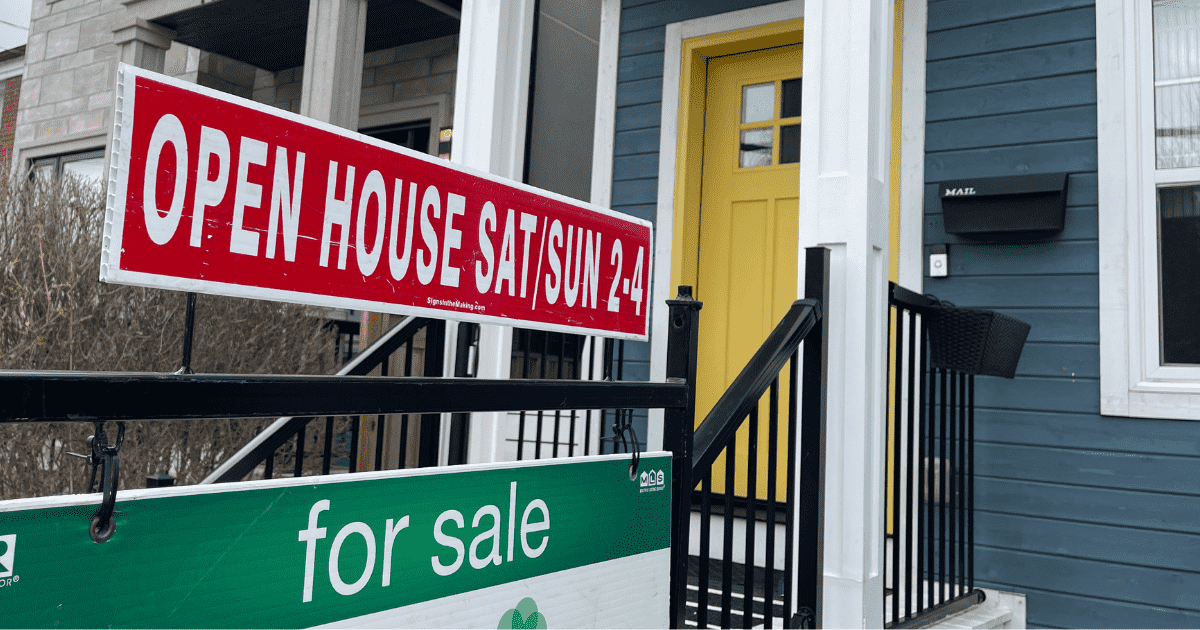
Market dynamics in Canada are shifting—and not uniformly. There is a growing divide between the country’s most and least expensive metros.
Depending on location, Realtors are seeing two very different scenarios play out in 2025. In the Greater Toronto Area and Metro Vancouver, demand is low and prices are seeing a year-over-year decline. In contrast, places like Quebec, the Prairies and Atlantic Canada, are seeing prices moving upwards and an active kickoff to the spring market.
Sluggish starts in Toronto and Vancouver
According to Royal LePage’s Q1 2025 House Price Survey and Market Forecast, Canada’s two most valuable real estate markets—Toronto and Vancouver—posted year-over-year price declines of 2.7 per cent and 0.7 per cent respectively in the first quarter (Q1) of the year. This reflects the broader trend of buyer hesitation in Ontario and British Columbia, regions weighed down by geopolitical tension, a looming federal election and consumer caution.
“The spring market has not sprung in Toronto,” said Shawn Zigelstein, broker at Royal LePage Your Community Realty. “It’s clear that consumer confidence is low, and that’s driving a major slowdown in the GTA housing market.”
Toronto’s aggregate home price fell to $1,146,100, while Vancouver’s settled at $1,230,100. Condos in both cities remain under particular pressure, with Toronto condos dropping 4.0 per cent and Vancouver condos slipping 1.7 per cent compared to 2024.
But, despite the pause in activity, neither city is seeing a collapse in prices. Instead, sellers are exercising patience, and buyers who are entering the market are doing so strategically, often negotiating from a position of strength in a more balanced environment.
Quebec and regional markets
While Toronto and Vancouver tread water, Quebec continues full steam ahead—particularly Quebec City, where home prices jumped an astonishing 17 per cent year over year, leading the nation for a fourth consecutive quarter. The Greater Montreal Area also posted strong gains, with a 7.9 per cent increase over the same period.
“Markets in Quebec, the Prairies and Atlantic Canada are demonstrating surprising resilience,” said Phil Soper, president and CEO of Royal LePage. “This uneven performance is a hallmark of a market in transition.”
In Quebec City, public sector stability and low exposure to industrial trade risks have kept consumer confidence alive and well. “As long as there are no concrete job losses, there is no collective stress that would slow down purchasing decisions,” noted Michele Fournier of Royal LePage Inter-Quebec.
Similar dynamics are playing out in regions like Winnipeg, Edmonton and Regina where comparatively affordable prices and low inventory are driving competition—even in the face of broader economic uncertainty.
Confidence divided along regional lines
Unsurprisingly, the national mood remains uncertain, with 49 per cent of Canadians expressing confidence in the economy, and 43 per cent not. Confidence varies widely across provinces: 65 per cent of Quebecers are optimistic, while just 34 per cent in Manitoba and Saskatchewan feel the same.
Among homebuyers, political and economic anxieties are having a tangible impact. Half of Canadians planning to buy in 2025 have postponed their purchases due to the trade dispute with the U.S. Concerns over the cost of living and market volatility are central to this hesitation.
“The typical spring market didn’t kick off as energetically as expected, and geopolitical uncertainty is playing a major role,” said Soper. “The new administration in Washington has rattled Canadians with aggressive rhetoric and punitive trade policy. While we were spared from the blanket 10 per cent tariff imposed on most countries in the world, targeted steel and aluminum duties – coupled with unsettling comments that called Canada’s sovereignty into question – have been enough to shake public sentiment. Even if these measures don’t directly impact housing, they contribute to a climate of caution that weighs heavily on large consumer decisions, at home and around the world.
Policy and political pressure in an election year
The federal election has added another layer of unpredictability. With housing affordability ranking as a top issue, all major political parties have rolled out proposals targeting supply and first-time buyers. Still, Soper cautions that long-term vision is essential.
“Any initiatives that make housing more accessible for young families and first-time buyers… are welcome,” he said. “But the decades-long shortfall of inventory our nation faces won’t be resolved overnight. It requires serious, long-term commitments.”
Forecasts and forward momentum
Despite a slower-than-expected start to 2025, Royal LePage is forecasting a 5 per cent increase in national aggregate home price by Q4 2025. This is a slight downward revision from previous projections, largely due to the muted activity in Ontario and B.C.
Encouragingly, Soper notes, economic fundamentals remain strong. Canada’s mortgage default rates are among the lowest globally, interest rates continue to fall and new inventory is coming online—albeit slowly.
“The housing market continues to provide people with a reliable foundation in uncertain times,” says Soper. “Real estate activity tends to rebound quickly when uncertainty lifts.”

