
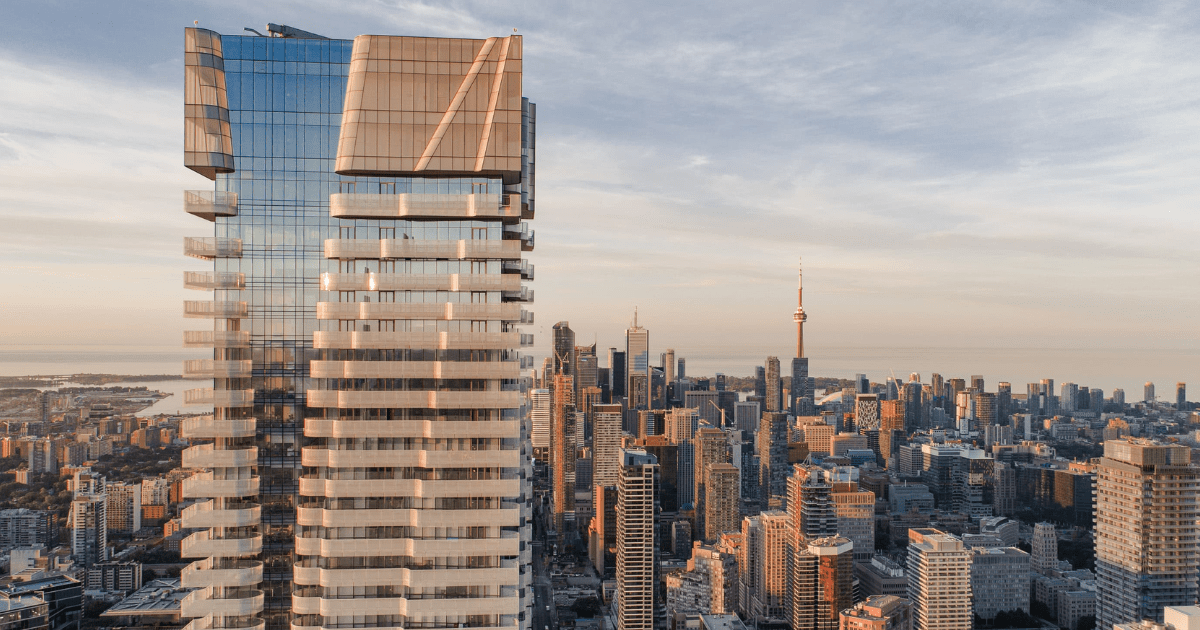
Image source: OneBloor.com
Toronto is poised to become a global leader for supertall tower developments as the city looks to build up, rather than outward, to increase housing supply and density.
Supertall towers are defined as being over 300 metres and can have over 100 storeys and over 1,000 units. There are currently nine supertall towers in development in Toronto, with another six proposed.
In October, the Council on Vertical Urbanism held a global conference in Toronto on supertall towers, where experts from around the world shared their insights on the growing trend.
Isaac Work, associate director for the Canadian office of the Council on Vertical Urbanism, told Real Estate Magazine that Toronto was chosen to host the conference to showcase the developments happening in the city.
Shifting market forces
Work said that cities across the world are turning to supertall towers due to increasing land value. He said there is a one-to-one correlation between land value and how much height a developer seeks to put on it.
“With the influx of immigration we’ve seen over the last few years… it’s unsustainable to continue suburbanizing,” he said. “There is a demand for densification in Canadian cities.”
However, Toronto is still lagging behind other cities around the world, Work said, when it comes to supertalls. U.S. cities such as Chicago and New York City have laid the stake in supertalls for years, not to mention Dubai or mega-cities in China, where towers can be over 600 metres – double what is in the works now in Toronto.
Before Canada’s ban on foreign ownership, Work said mainly investors, some from out of the country, were the ones buying up supertall condo units in Toronto, encouraged by their unobstructed views that can help retain the condo’s value. Since the ban, though, supertall developers are leaning more into purpose-built rentals rather than luxury units to appeal more to average buyers, according to Work.
Pushing the limits of design and technology
Mansoor Kazerouni, supertall developer Arcadis’ global director of architecture and urbanism, attended the conference himself and told REM that he was amazed by the technological innovations on display there. For example, developers are experimenting with building design, such as holes in their middle to allow wind to pass through and prevent sway, as well as new advances in elevator technology. That includes elevators that not only travel vertically but also horizontally, which can allow them to service other adjacent buildings.
“It’s kind of eye-opening,” he said. “The technology is frankly limited by our imagination, but if we open ourselves up to it, we will discover whole other forms of development that will yet again redefine what living in a tall building means.”
Arcadis has designed the supertall tower at 19 Bloor West in Toronto, which is proposed to be 99 storeys and 317 metres.
Building the future
Kazerouni said that supertalls can be more complex to build than regular towers. For example, installing a “tuned mass damper” on the M3 building in Mississauga, which technically is right below the supertall threshold at 267 metres, required about 60 trucks. He said it took around two months to get the 700 tonnes of steel to the top of the tower, but it was necessary to install the equipment that prevents building sway.
Still, Kazerouni insists it’s worth the extra work to make a supertall tower, as it can help cities prepare themselves for the distant future.
“You can’t think of the city in its current context, you’ve got to think of it in 30 and 50 years,” he said. “What’s the city going to need? And where are you going to accommodate those needs? So you’ve got to make sure that we are developing these sites to their best potential.”
Could that mean flying cars in the future, like in The Jetsons, shooting in between supertalls? Kazerouni isn’t ruling out anything.
Who wants to live that high?
Supertall towers aren’t for everyone, though. Property.ca real estate agent Sean Miller told REM that his agency represented One Bloor East, which is just below the supertall threshold at 257 metres tall, but he didn’t receive much interest in the units there. He said buyers have been more interested in smaller, boutique buildings rather than being high in the sky, and a sense of vertigo can form when being so high up.
Miller recalled seeing the penthouse unit at One Bloor East on a cloudy winter day and realized when he looked out the window that they were above the clouds.
“A lot of people just don’t feel comfortable being up that high,” he said. “It was very eerie.”


Eric Stober has over 10 years experience as a journalist and writer at publications big and small, including Global News, Toronto Life, Post City Magazine, Greencamp.com, the Toronto Star and The Grid.