
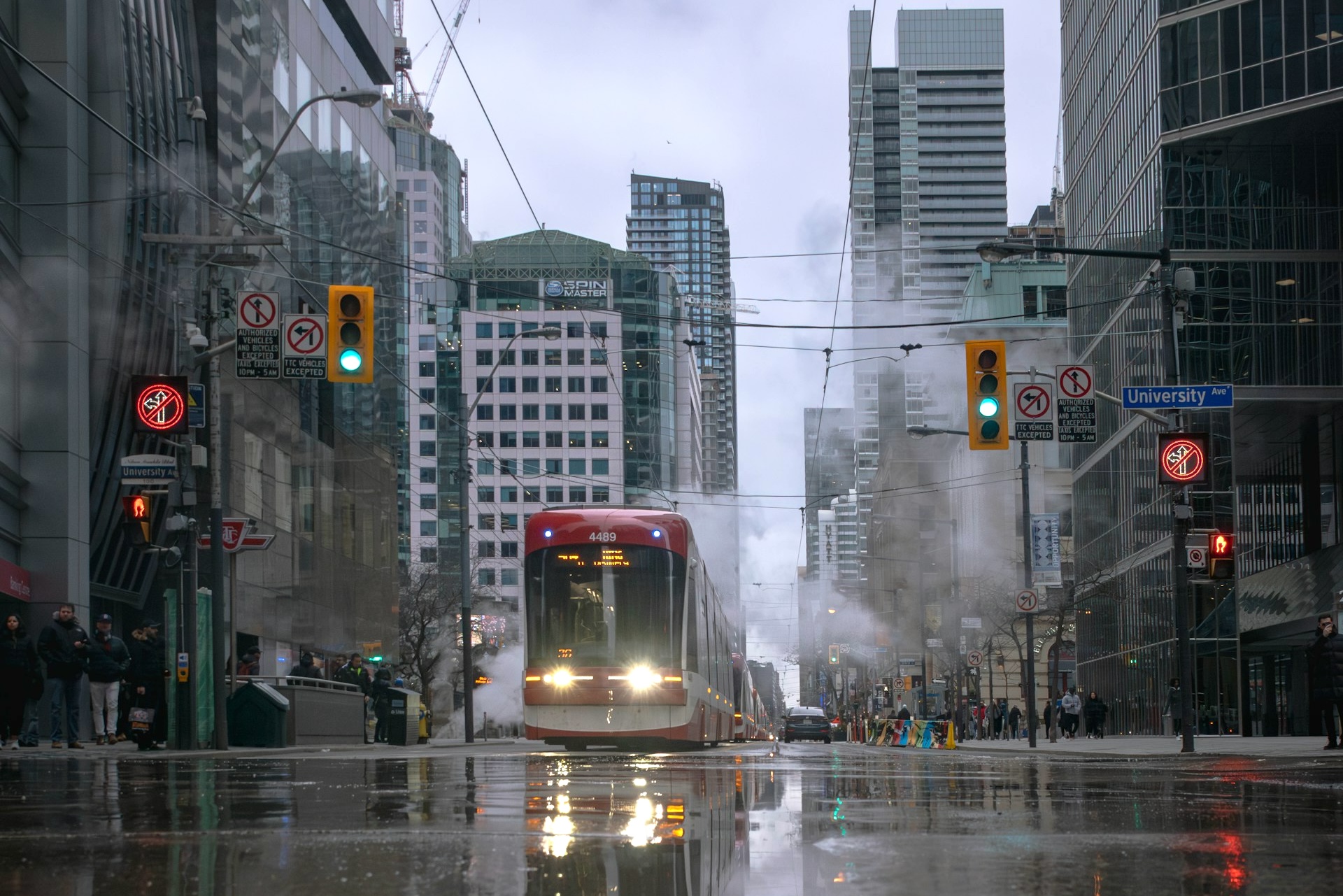
Transit access has long been one of the biggest drivers of Canadian real estate value, but does that always make sense? Statistics Canada (StatCan) data shows public transit revenues have recovered to 2019 levels, but ridership hasn’t. Most experts dismiss this as a temporary dip that will resolve in the near future. However, what they’re missing is how soaring home prices have destabilized core transit users—just as the country nears the end of a long-wave cycle that could leave this premium misaligned for years.
How Access To Transit Influences Canadian Real Estate Values
If location, location, location is the biggest driver of real estate values, transportation is what makes that location usable. Suburbs connected to major cities by a quick train ride command a premium; homes at the end of a dirt road don’t. In cities, proximity to subways or light rail helps to boost prices, while properties technically in the city but disconnected from transit tend to trade at a discount. The relationship is fairly straightforward: public transit isn’t just an amenity—it’s the system that connects other amenities.
Makes sense, right? It comes down to a fundamental economic concept: time value of money (TVM). In this context, time is worth money, so people pay a premium for public transit because it saves them time. Developers build around this demand driver, promoting densification around transit hubs—with some going as far as speculating on future transit lines. Policymakers follow a similar playbook, providing funding and incentives for densification around these areas. This stimulates further demand in these areas, driving this premium even higher.
With so much effort poured into boosting transit demand, ridership must be surging—right?
Canadian Transit Revenue Is Back—Riders Aren’t
Canadian Urban Transit Revenues (Excluding Subsidies) v. Trips.
Source: Statistics Canada; Better Dwelling.
Canadian cities saw public transit pull in $352.8 million in September, up 1.7% (+$6.71 million) from last year. That’s the highest monthly revenue since January 2020, and just 4.4% below the pre-pandemic peak in September 2019. It was also the third-highest September on record. Revenues have nearly recovered from the pandemic—a promising sign, at first glance.
Ridership isn’t following revenue. Canadians took 134.5 million public transit trips in September, down 4.8% (-6.8 million) from last year and still 18.0% (-29.5 million) below September 2019. Transit made some gains since 2020, but the recovery has stalled—ridership is now sliding into a second decline.
That’s remarkable given Canada’s population surge. The country added 3.85 million people between September 2019 and 2025. If just half of them took transit twice per weekday, it would have added an average of 83 million trips per month. Instead, ridership is still down by 29 million trips compared to before the pandemic.
It’s easy to appreciate the argument that transit is underfunded and strained by capacity issues. But that’s not what the data shows—revenues are up, riders are down. It’s not just remote work either, with policymakers recently ordering government workers back to the office last year to support real estate prices. What’s happening isn’t a funding problem, but a sign of a structural shift in how people move—and what they value.
How Canadian Real Estate’s Transit Premium Undermines Ridership
Let’s revisit TVM. People pay a premium to live near quality public transit—but that premium has a ceiling. When home prices rise too quickly, the value proposition breaks. One UK study found new transit lines front-loaded value, with prices stagnating for 15 years after opening. These homes may still be well-located, but the premium eventually outweighs the benefit. Households with modest incomes, who rely on transit, have greater incentive to move further out—often to car dependent suburbs, and trade time for affordability and space.
The pandemic-era suburban shift is often attributed to remote work, but this also happened during the 1990s and 1980s bubbles. This isn’t new—it’s a classic response to urban pricing. It isn’t just suburban flight either, with Ontario’s young adults migrating to Alberta in record volumes. The inefficiencies that follow a real estate bubble are so large that a dedicated bus lane won’t change their minds.
There’s a second-order effect too. Transit-adjacent homes still command a relative premium, having the best locations. However, the demographic that can now afford those homes have a different TVM problem—a lot more money than time.
The higher the wage, the higher the opportunity cost of not using door-to-door transportation. Add 20 minutes to a commute and you lose 174 hours a year—equivalent to $6,300 in labor at the average wage in Canada, though that wage would be too low to support ownership in these regions. This demographic may use public transit, but they aren’t a core user of the services. If their time is worth $1,000/hr, they may choose to take transit—but that’s a choice, not a necessity.
Declining Transit Ridership Signals A Deeper Cycle Risk
Policymakers, developers, and investors are viewing reduced transit ridership as a cyclical problem that resolves soon. What many may not realize is there are three cycles: cyclical, secular, and structural (long-wave).
Cyclical cycles are the classic business cycles—roughly 10 years long, driven by credit. The housing market follows this pattern: expansion, peak, recession, recovery. Cooling credit growth, rising insolvencies, stubborn inflation, and fading discretionary demand—these are signs this cycle is just past its peak.
Secular cycles span 20-30 years, shaped by generational forces like tech adoption and demographic peaks. As the dominant cohort ages, family size shrinks, household formation slows, and downsizing begins. These are sometimes called infrastructure cycles, since they reflect how a generation builds and uses housing, transit, and public services.
Structural (long-wave) cycles play out over 40 to 60 years, driven by a major technological shift—think steam engines, cars, or computers. These eras bring long booms, sharp inflation, and the claim that shortages—not demand—drive price growth. Policymakers respond with huge investment, but it arrives just in time for the technological shift. What’s left is overinvestment in the wrong places during a boom, and policy support during a downturn to lock in those mistakes.
Canadian Real Estate Is Facing The End of All 3 Economic Cycles
So what does any of this have to do with real estate and public transit? Simple: cyclical peaks stretch valuations, especially for transit-adjacent properties. Normally, prices correct, it resets, and returns to efficient use. However, something bigger is happening here.
We’re also in the middle of a secular shift—Millennials, the core demographic that drove transit demand, are aging out. Their needs are changing. Behaviour is shifting on a generational timeline, making real estate premiums tied to old patterns harder to justify.
At the same time, we’re in a structural cycle, where decades of overinvestment collide with new technology that reshapes how cities function. The risk isn’t just that demand is fading—it’s that we’ve locked in spending based on how the larger and older voter base thinks Millennials live.
When behaviour, policy, and capital diverge this far from reality, the correction isn’t gradual. It snaps.