
It’s a conversation that just won’t quit: Ontario’s population is growing while its homebuilding efforts continue to fall woefully short of what the province objectively needs to house its residents.
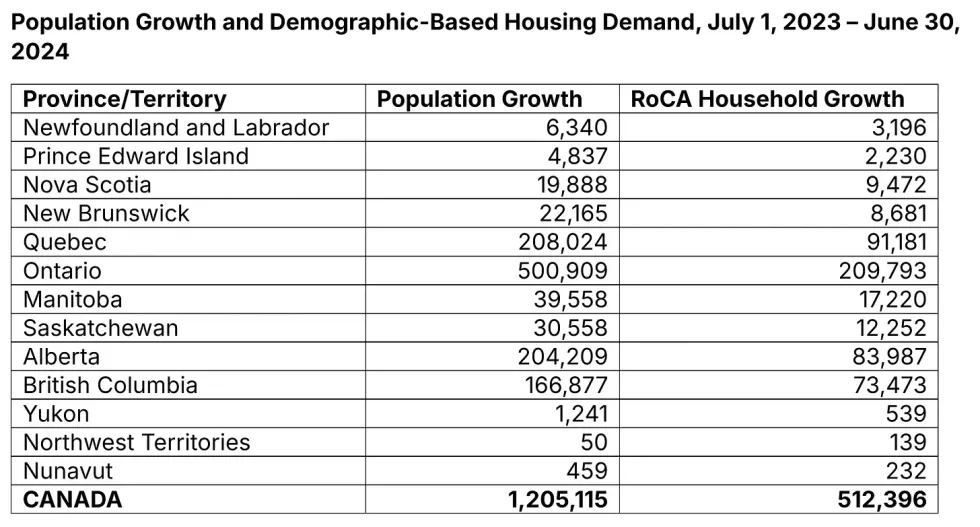
On Wednesday, the recently-minted Missing Middle Initiative (MMI) revealed that the Province’s population grew by around 500,000 between June 1, 2023 and June 1, 2024. But, by contrast, it added just 82,000 new homes during the same time period. The MMI says that Ontario actually needed some 200,000 new homes to keep up with the rate of population growth last year. That means that Ontario built around 40% of what it needed.
“This disconnect, which has been occurring for several years, is the primary contributor to the housing crisis,” the MMI said on Wednesday. (This data, MMI also noted, represents the first instalment of their Canadian Housing Microresearch Project.)
As for how the MMI is discerning the number of new housing units needed, it’s based on their own tool called the RoCA (“Rest-of-Canada”) Benchmark, which considers the number of households a community would have given their population’s “age-adjusted headship rates” as of 2016.
missingmiddleinitiative.ca
“What this benchmark is doing is converting the population of a place into an expected number of households,” the MMI said. “The expected number of households a place has will differ from the actual number of households, in part because the number of houses available in an area limits the number of households that can be formed.”
And that’s just to say that the RoCA Benchmark considers that “the actual number of households” is often stifled by housing shortage realities, and instead portrays the number of households a place should have.
While the MMI acknowledges that the RoCA Benchmark is far from a “perfect tool,” it does provide a gauge backed by figures that are hard to argue with. Canada’s population rose by 1.2 million persons according to Statistics Canada’s last count (between July 1, 2023, and July 1, 2024), and, as mentioned, Ontario added some 500,000 persons.
“Plugging this data into the RoCA formula, Canada would have needed to add over 500,000 homes, with 200,000 of those homes in Ontario,” the MMI iterates.
Broadly speaking, it seems that almost no Canadian province “was able to keep housing starts in line with population growth” in 2024 — the one exception being Nova Scotia, where household growth was “head and shoulders” above the norm. “Five provinces started less than half the houses they needed to keep up with population growth, with Ontario having the biggest housing shortfall,” the MMI said.
 missingmiddleinitiative.ca
“The disconnect between population growth and the increase in housing supply is the prime cause of the housing crisis. Population growth will be slower in future years as the federal government has made a number of changes to immigration targets and non-permanent resident programs,” it adds. “However, as a country, we also need to raise our homebuilding game to keep up with future population growth and account for pre-existing housing shortages.”
In any case, Ontario’s homebuilding shortfall, magnified on Wednesday, is more or less old news at this point. In fact, we heard from the Smart Prosperity Institute (which notably, is linked to Mike Moffatt, one of the minds behind the Missing Middle Initiative) this past November about the fact the homebuilding efforts in Ontario have been sheepishly behind that of other provinces for many years.
“Over the last six years, Ontario has ranked in the bottom half of provinces in terms of homebuilding per capita. In terms of homebuilding per 100 new residents, the province finishes [eighth], ahead of only New Brunswick and Saskatchewan,” the November report said. “The picture is only getting worse for Ontario. Recently released CMHC data shows that from January to October 2024, Ontario started 13,000 fewer homes than the previous period last year, while the rest of Canada started 14,000 more homes.”
As for Ontario’s goal of 1.5 million new homes by 2031, it seems that, based on data release after data release, the Province will be hard pressed to meet it.
Though there is some cause to be optimistic. The City of Vaughan recently reduced its development charge rate across the board, hitting a pain point that has been loudly articulated in the development community. The change means that the DCs linked to a single low-rise home (single- or semi-detached) has been nearly cut in half. Meanwhile, the City of Toronto has passed a package of measures to offset the cost-to-build crisis by reducing development costs and property taxes for a defined period.
Most recently, the City of Mississauga put out a new housing task force report (released on Wednesday) that highlights what’s being done in the city to rectify its housing crisis and better support housing development. That includes the waiving of holding zones, site plan, and minor variances for non-profit housing providers to encourage more affordable housing, the provision of grants to cover DCs for fourplexes, and the provision of pre-approved design plans for garden suites.