
The Prairie provinces are each seeing different trends in commercial real estate, according to June REMAX reports. These differences are driven by varying levels of population growth, infrastructure spending, policy changes, and sector-specific performance.
While Alberta leads in terms of investor activity and asset diversification, Saskatchewan continues to show surprising resilience in a high-rate environment, and Manitoba displays cautious but steady growth with targeted intensification. Together, these markets show a broader shift in the region toward more diversified economies and increasing interest in long-term CRE investment.
Alberta: Multifamily Surge, Industrial Powerhouse, and Retail Realignment
Edmonton and Calgary continue to be Alberta’s CRE anchors, but the composition of investment and development varies significantly between the two.
In Edmonton, the multifamily segment remains the dominant force. The city welcomed over 72,500 new residents between July 2023 and July 2024, pushing the population past 1.6 million and straining an already tight rental market. The average rental rate has now climbed above $1,500/month, according to Rentals.ca and Urbanation. With institutional players largely absent from the multifamily space, mid-sized investors and private developers—often in partnership with the City—are driving infill projects, especially around universities. A record number of purpose-built rentals were delivered in 2024, aided by CMHC incentives such as longer amortizations and 5% down payments under the Housing Accelerator Fund. However, some developers are constrained by limited refinancing options.
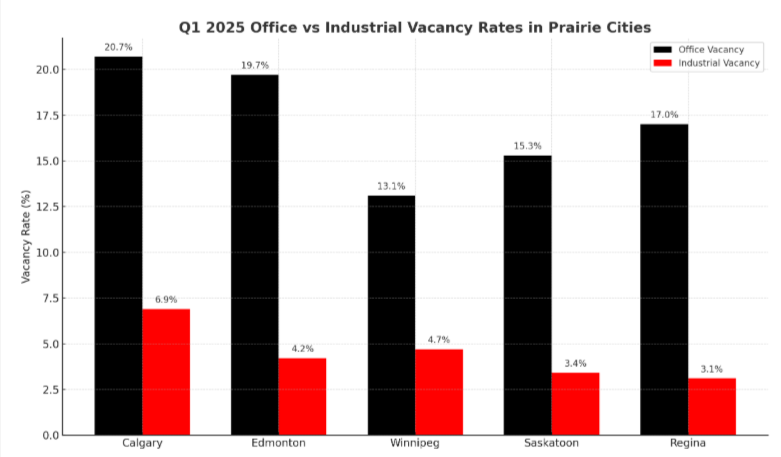
Edmonton’s zoning reforms introduced in 2024 are enabling small-scale multifamily projects (up to 8 units) on infill land, contributing to an expanding “missing middle” inventory. The retail sector, meanwhile, is seeing robust suburban demand, with service-based tenants like healthcare practitioners displacing traditional apparel and discretionary retail. Industrial fundamentals remain strong, particularly in Acheson and Parkland County, though new supply in H2 2025 may soften availability pressures. Conversely, the office market is still lagging, with B- and C-class assets experiencing persistent vacancy and only AA towers like Stantec drawing tenants.
Calgary, in contrast, is undergoing a full-spectrum transformation. Immigration-fueled growth and interprovincial migration have supercharged the city’s multifamily investment, with 3,000 starts in Q1 2025 alone and 65% of those being purpose-built rentals. REITs and institutional buyers have been especially active. Notable transactions include Boardwalk REIT’s $80M acquisition of The Circle and a $93M buy-in of Windsor Park, reflecting investor confidence even amid elevated rates.
Calgary’s office market, though still challenged, is seeing a gradual recovery. The city’s downtown office conversion program has approved 11 projects (2 completed), totalling 1,500 new residential units. Availability dropped to 20.7% in Q1 2025 from 22.6% in 2024, signalling improving absorption. Industrial development is also booming, with the Prairie Economic Gateway project poised to create over 30,000 jobs and $7B in economic activity. Calgary’s bid to become a major inland logistics hub is reinforced by growing demand for mid-size and single-use industrial bays. Meanwhile, the retail sector is evolving toward experiential formats, highlighted by immersive offerings at CF Chinook Centre and the increasing value of retail nodes in neighbourhoods like Inglewood and 17th Avenue.
Saskatchewan: Tight Conditions, Steady Fundamentals, and Undersupplied Multifamily Markets
Saskatchewan continues to defy broader macroeconomic headwinds, with Regina and Saskatoon both reporting housing price gains, tightening inventory, and elevated demand for industrial and multifamily assets. While lacking the institutional capital seen in Alberta, Saskatchewan markets are demonstrating consistent growth supported by stable population increases and resource-based economic activity. It also offers a relatively low-barrier entry for private investors looking for long-term upside without the competition seen in larger urban centres.
Saskatoon is particularly active in the industrial segment, with consistently tight vacancy rates and new speculative builds continuing in core industrial parks. Demand stems from agri-business, manufacturing, and construction-related services. On the multifamily front, both cities face rental supply shortfalls. Developers remain cautious amid high financing costs, but demand continues to outpace new starts. Purpose-built rentals remain sparse, and rent increases have outstripped wage growth in many submarkets.
Retail is evolving more slowly, with big box and suburban strip centres still dominant. However, smaller boutique clusters are emerging in Saskatoon’s Riversdale and Regina’s Warehouse District, driven by local entrepreneurs. Office performance remains weak in both cities, mirroring broader trends across mid-sized Prairie markets, although Regina’s government-sector tenancy offers some stability.
Manitoba: Measured Growth, Urban Intensification, and Industrial Stability
Winnipeg, the primary market in Manitoba, has experienced slower growth, largely concentrated in infill and core industrial assets, with local developers playing a leading role. Population growth is trending upward but remains below Alberta and Saskatchewan levels. Despite that, Winnipeg is actively working to address rental housing shortages and improve land use efficiency through a mix of policy reforms and targeted development incentives.
The multifamily sector is expanding. Rental vacancy rates have tightened across most neighbourhoods, particularly in downtown and inner-ring suburbs. CMHC support programs are being leveraged, but construction timelines are slow, and capital constraints are more evident than in Alberta.
Winnipeg’s industrial sector remains a pillar of the commercial market, driven by logistics and food processing. Major infrastructure upgrades—particularly those connected to CentrePort Canada—are adding long-term appeal for national tenants and developers. However, industrial availability is tighter than ideal, and speculative builds remain limited.
Retail has remained relatively static, with limited new mall or large-format development. However, downtown and inner-city revitalization initiatives have introduced some mixed-use projects that blend residential and commercial. Office space remains challenged, but not as severely as in Calgary or Edmonton, partly due to the city’s modest development pipeline as well as other factors.
A Three-Speed Prairie Region
Alberta continues to lead Prairie markets in multifamily development, institutional investment, and industrial growth. Calgary stands out for its logistics buildout and downtown office conversions, while Edmonton is seeing steady rental expansion and strong demand for suburban retail. Saskatchewan remains stable, with tight rental and industrial markets offering potential value for mid-sized investors. In Manitoba, Winnipeg, as the key market, is growing more gradually, with a focus on industrial infrastructure and modest gains in rental housing.
Despite local differences, all three provinces are seeing increased activity in multi-unit residential and industrial assets, underpinned by population growth, affordability constraints, and shifting economic patterns.