
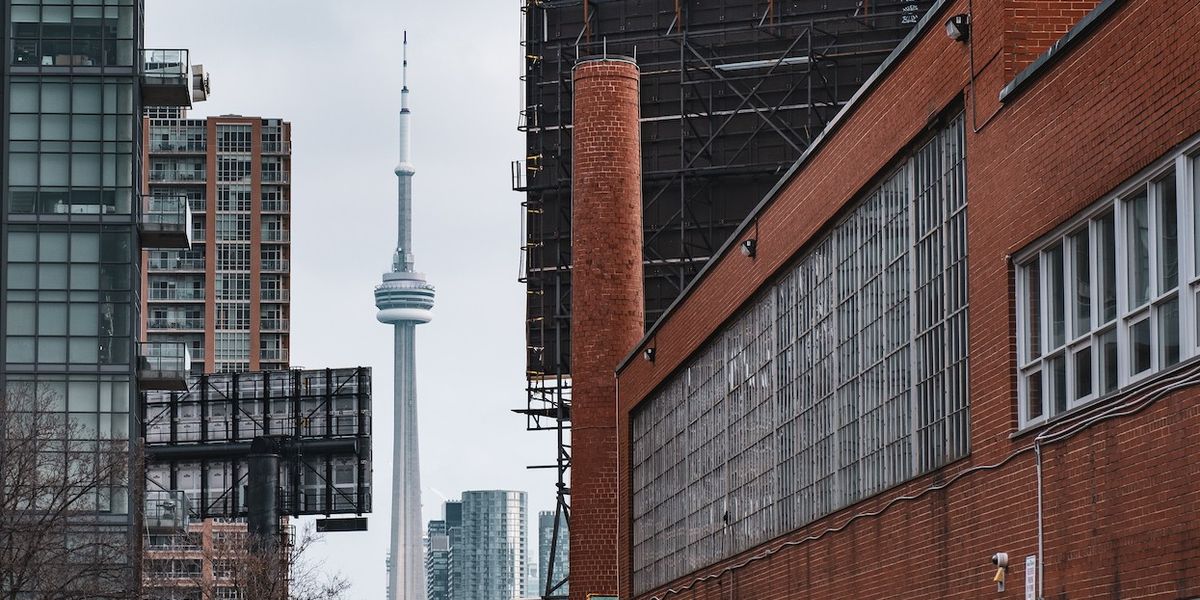
Month after month, housing supply is building up on the Toronto real estate market as sales continue to fall flat. Meanwhile, condo inventory makes up more than half of the supply out there. According to the latest data from the Toronto Regional Real Estate Board (TRREB), there were 11,705 active listings in the City of Toronto at the end of May, and of those, 6,855 were active condo listings.
That means that almost 60% of the available inventory in the city is condo supply, which isn’t necessarily news to anyone with an ear to the ground of the market — plus, that figure has moved back and forth between 59% and 66% since last spring — but it does give us some insight into what we’re in for when it comes to the future of new condos in the city.
Speaking to the glut of condo inventory currently on the market, TRREB’s Chief Information Officer Jason Mercer says it’s “by and large” resale, and that the contrast of roaring supply and sluggish demand is “fairly unique” to this point in time, and particularly against the context of condo sales — those amounted to 973 in May — which are down around 25% year over year.
“You have to take into consideration that the issue with the condo market is that the stock has been growing over time as well. So you’d expect to see the active listings numbers trending upwards generally over time just because that’s a segment of the market where we’d be seeing the most home construction,” he says. “As a share of the overall housing stock, condo apartments have been accounting for a greater and greater share year in and year out, really, over the last couple of decades.”
Jason Mercer, Chief Information Officer at the Toronto Regional Real Estate Board
“If we have a lot of inventory and a lot of sales, the market could be tight,” Mercer adds. “But what we have right now is a disconnect between inventory and sales. We always want to look at the demand and supply side together, because if I had 50,000 active listings, but I had 40,000 deals, the market would be super tight. We’d be seeing double-digit price growth.”
Beyond the sheer amount of inventory sitting untouched on the market, the expected timeline of absorption has some shock-value to it as well. Urbanation President Shaun Hildebrand estimates that, at the May level of sales and active listings, there is seven months of supply currently on the market — which indicates, undoubtedly, that the city is in buyers’ market territory.
In addition, further to Urbanation’s condo market report put out in April, Hildebrand shares there are 6,402 unsold units in pre-construction, 5,986 unsold units under construction, and 1,149 unsold new units in standing inventory in the City of Toronto alone. These are figures not reflected in TRREB’s monthly report.
“The record level of resale inventory on the market is putting downward pressure on condo resale prices, which fell 7.3% annually in May. As resale condo prices decline, it makes new condos, which are generally priced above resale units, less competitive and reduces their attractiveness to buyers,” Hildebrand says. “This results in fewer new condo sales and fewer new project launches. It also creates complications for buyers who pre-purchased units that are reaching closing. If resale prices are declining, new condo units may not be worth their contracted price, causing issues with obtaining a mortgage.”
 Shaun Hildebrand, President of Urbanation
When asked if this has happened before, Hildebrand points to the “biggest correction” during the 1990s. “It took basically a full decade for the condo market to recover,” he adds.
“In the last 25 years, the new condo market has generally operated in four to five year cycles. The resale market has historically been the leading indicator for the new condo market and they tend to move together with only a small lag,” says Hildebrand. ”The key signs of recovery will be resale activity rising back to more historically average levels, resale inventory falling back to four months, and prices beginning to move up again.”
In any case, Mercer underscores that we shouldn’t be taking the numbers we’re seeing today lightly. “There’s so much inventory on the resale side and you’re not seeing a lot of new home sales, you’re not seeing a lot of project launches,” he says. “And that is a concern, medium to long term, because we are going to reach this point in sort of the housing supply pipeline where we hit this low… we’re going to be looking at a real drop off in completions.”