

In Canada, real estate has long been more than a roof over one’s head. It’s been a store of wealth, a retirement strategy, a family legacy—and increasingly, a fault line in intergenerational fairness. The gap between the haves and have-nots is often measured in property lines, and the 2025 federal election will reflect that tension.
Over the past two decades, housing affordability has become a defining issue for Canadians. For many younger voters, homeownership feels further away than ever. For older investors, property has been a financial windfall. Housing is no longer just a policy issue—it’s a political one.
Each major party—the Conservatives, Liberals and NDP—has put forward a vision to fix Canada’s housing system. These proposals differ in tone, execution and economic philosophy.
Source: Valery.ca
Conservatives: Unlocking trapped wealth to fuel growth
A tax deferral to get capital moving again
The Conservative Party’s “Canada First Reinvestment Tax Cut” targets the enormous capital tied up in real estate and other assets. Under this plan, individuals and businesses could defer capital gains taxes on the sale of these assets if the proceeds are reinvested into active Canadian businesses.
Unlike traditional tax cuts, this proposal doesn’t forgive taxes—it delays them until the new investment is sold or moved offshore. It’s intended to redirect passive wealth into more productive sectors.
Inspired by the U.S. 1031 exchange—but broader
This plan echoes the U.S. 1031 exchange, which allows real estate investors to defer capital gains taxes by rolling over proceeds into new properties. But the Canadian version expands this idea beyond real estate. Investors could cash out of property and reinvest in sectors like tech, clean energy or manufacturing.
Implications for investors and sellers
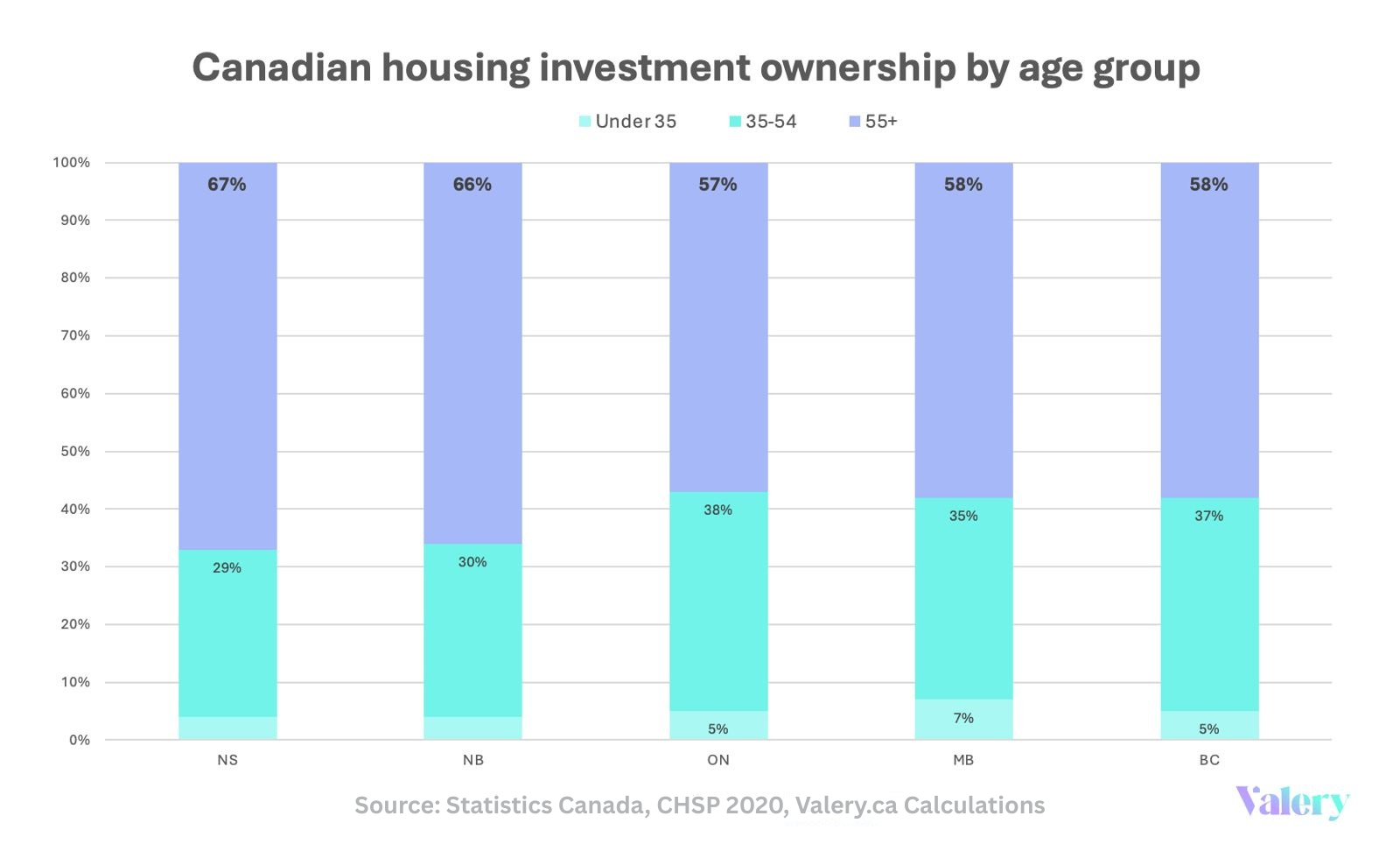
For real estate investors, especially those aged 55 and older— who make up the majority of investment property owners in provinces like Ontario, B.C. and Nova Scotia, according to Statistics Canada—this proposal could offer a strategic and tax-efficient way to exit the market. By deferring capital gains taxes, it provides an incentive to sell long-held properties without facing an immediate tax hit, potentially unlocking significant housing supply. That shift could ease pressure in tight markets, boost listing volumes, and redirect dormant capital into more productive sectors of the Canadian economy.
Source: Valery.ca
It’s also a subtle bet: that Canadian investors, if given the choice, would rather reinvest in the national economy than park their wealth abroad—a trend already visible in 2024 when Canadians ranked as the top foreign buyers of U.S. real estate.

Source: Valery.ca
Liberals: Building at historic scale
Build Canada Homes (BCH) Proposal: Doubling supply ambitions
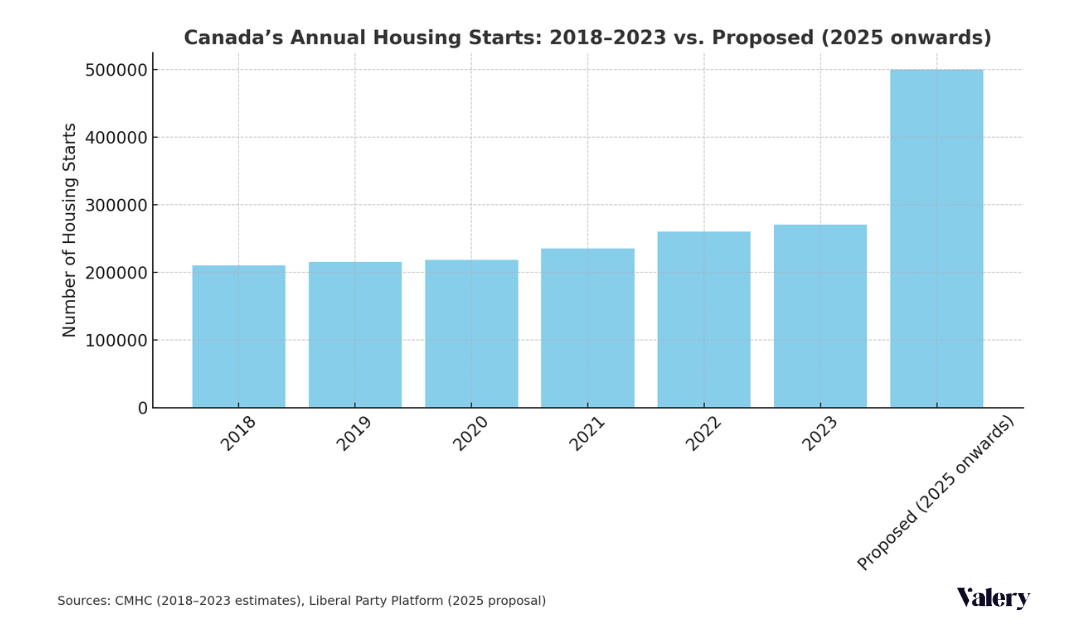
Under the leadership of Mark Carney, the Liberal Party’s Build Canada Homes (BCH) proposal outlines a plan to double Canada’s annual housing output to 500,000 homes. This represents a level of direct government involvement not seen since the post-war era.
The chart below puts this ambition in perspective by comparing the proposed target to actual housing starts over the past six years. While Canada has been producing between 210,000 and 270,000 homes annually, the BCH target would mark a near-doubling of that rate—a dramatic increase in national housing output
The strategy includes development on public land, significant investment in prefabricated housing technology, and incentives for affordable housing construction.
Lowering costs for buyers and builders
A centrepiece of the BCH platform is the elimination of the GST on homes under $1-million for first-time buyers. In places like Toronto or Vancouver, this could mean immediate savings of tens of thousands of dollars. Additional measures like reduced development fees and fast-tracked zoning approvals are designed to further lower costs and speed up project delivery.
What it means for the market
First-time buyers stand to benefit most in the near term. Cheaper builds, reduced taxes, and increased supply could open doors that have been closed for a decade.
For real estate investors and developers, the impacts are more complex. A sudden increase in supply could soften price appreciation and lower rental margins. On the flip side, accelerated zoning and federal funding could make new builds more attractive and less risky.
The BCH plan imagines putting the federal government back in the builder’s seat—but whether a future Liberal government could deliver on timelines, cost control, and intergovernmental coordination remains to be seen.
NDP: Empowering buyers and restraining speculation
Mortgage relief for first-time buyers
The New Democratic Party is focusing its housing platform on affordability for everyday Canadians. Their standout policy is a federally backed low-interest fixed mortgage specifically for first-time buyers.
With borrowing costs among the highest in recent history, this plan could offer critical relief. A reduction of just 0.5 per cent in mortgage rates could save buyers between $9,000 and $12,000 over five years.
Targeting corporate landlords
The NDP also proposes a ban on corporate landlords acquiring existing affordable housing — a move designed to prevent large firms from driving up rents and shrinking supply. Additional funding for non-profit housing and support for co-op models further signal the party’s commitment to housing as a public good.
Rebalancing the investor equation
This proposal is the most critical of the investor class. It prioritizes long-term affordability over short-term profit and signals a shift toward a more regulated rental landscape. While socially motivated investors and non-profits may find new opportunities, for-profit landlords could see their acquisition paths and margins squeezed.
The NDP’s message is clear: housing is a human right, and market forces alone can’t be trusted to deliver fair outcomes.
Why first-time buyers are the key to market health
Targeting first-time buyers isn’t just good politics — it’s sound economics. According to the Bank of Canada, first-time buyers consistently make up around half of all home purchases in Canada. As the chart below shows, they represent the single largest segment of buyers — more than repeat buyers and investors combined.
When first-time buyers enter the market, it sets off a chain reaction. Sellers move up, new construction is absorbed more efficiently, and rental pressure eases. In essence, a housing market with active first-time buyers is a housing market that moves.
This is why both the Liberals and NDP have made first-time buyers central to their platforms—and why any policy that overlooks them risks leaving the entire system sluggish

Competing visions, shared stakes
While each party offers a different solution to Canada’s housing crisis, their proposals reflect deeper philosophical differences.
The Conservatives want to unlock private capital and redirect it toward productivity. The Liberals want to build aggressively and reduce friction in the system. The NDP wants to protect affordability and reign in corporate control.
For real estate investors, these proposals could reshape everything from exit strategies to regulatory compliance. For homeowners, particularly first-time buyers, the changes could determine whether a down payment is within reach—or just out of range.
What unites all three visions is a recognition that Canada’s housing system is not working as it should. And in 2025, housing policy won’t just determine who wins the election— it could determine who gets to call this country home.

Daniel Foch is the Chief Real Estate Officer at Valery.ca, and Host of Canada’s #1 real estate podcast. As co-founder of The Habistat, the onboard data science platform for TRREB & Proptx, he helped the real estate industry to become more transparent, using real-time housing market data to inform decision making for key stakeholders. With over 15 years of experience in the real estate industry, Daniel has advised a broad spectrum of real estate market participants, from 3 levels of government to some of Canada’s largest developers.
Daniel is a trusted voice in the Canadian real estate market, regularly contributing to media outlets such as The Wall Street Journal, CBC, Bloomberg, and The Globe and Mail. His expertise and balanced insights have earned him a dedicated audience of over 100,000 real estate investors across multiple social media platforms, where he shares primary research and market analysis.