
This article was written and submitted by Carl Laffan, a Toronto-based architectural design manager specializing in office, residential, mixed-use projects.
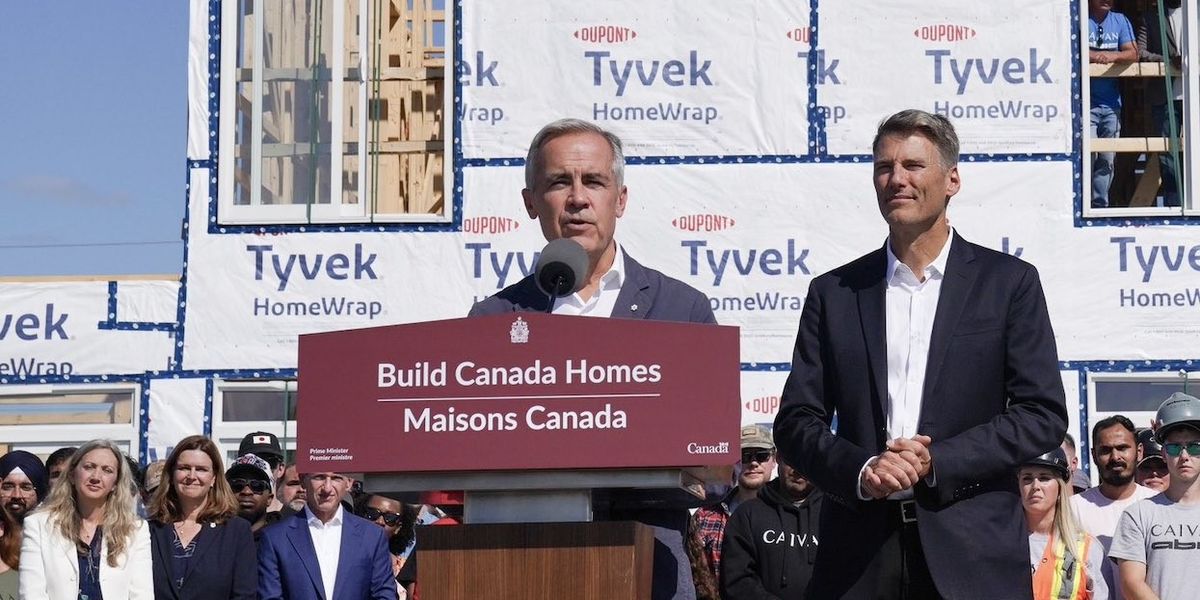
On September 14th, the federal government launched Build Canada Homes (BCH) — the “one-stop shop for affordable housing” that promises a “bold new approach and unprecedented investments to increase the housing supply in Canada.” The new federal agency has already proposed several positive initiatives and immediate investments that promise to deliver up to 45,000 new factory-built homes.
While this announcement is a very welcome step in addressing Canada’s housing crisis, BCH’s first tranche of housing may not even deliver 1% of the greater goal set earlier this year by Canada Mortgage and Housing Corporation (CMHC), who estimate Canada needs up to 4.8 million new housing starts by 2035 to restore affordability. Unless BCH can ignite the private sector and provide serious relief to market-rate home-buyers and renters, the vast majority of Canadians may see little change despite billions being invested.
Commendably, Build Canada Homes will focus primarily on non-market housing with much-needed initiatives for low-income households, partnerships with Indigenous communities, and supportive measures to fight homelessness. Notably, however, there is not a single mention of the growing crises around senior living or student housing, nor any specifics as to how BCH will address affordability for middle-class and market-rate homebuyers and renters.
The announcement does make mention of two main instruments in the BCH toolkit: “flexible financial incentives” for the private sector (of which no details are provided) and “leveraging public land” – more specifically, giving BCH access to “88 federal properties suitable for housing… which span 463 hectares or approximately the size of downtown Ottawa.” Sounds great on paper, but upon reviewing the portfolio, less than 1% of these land holdings are located within the country’s three most populous cities. This will not materially impact supply or affordability in our densest urban locations where land value and demand is at its highest.
The announcement concludes with the promise of “additional measures” to be announced in Budget 2025 on November 4th, which begs the all important question: What additional measures will BCH offer the market to create the right conditions to deliver the right homes at the right price? There are five low-hanging policy levers that also reinforce the key pillars of BCH’s approach could achieve exactly this.
1. Densification bonuses
If the aim is increasing supply, high-density housing will be critical to meet CMHC’s targets. Yet high-rise developments can be exponentially more expensive to build and have long been subject to disproportionate Development Charges (DCs) with costs typically getting passed onto the homebuyer. The infrastructure (roads/sewers/power, etc.) required for high-rise development is lower than single-family housing. Actively rewarding densification through reduced DCs and/or bonus buildable area to reduce housing prices should be table stakes. It could be further incentivized where projects include a surplus of affordable units.
2. Rebates on Canadian-made materials
A key pillar of BCH is to adopt the government’s new Buy Canadian Policy, thereby “strengthening domestic supply chains, scaling up a home-grown housing industry, and creating high-paying careers across the country.” If a percentage of a private development is built with Canadian-made materials (lumber, steel, aluminum, mass timber, etc.), a commensurate percentage of government fees/taxes/DC’s should be waived.
3. Extension of temporary GST/HST Rebates beyond purpose-built rental
The existing rebates help offset the extended return-on-investment period involved with purpose-built rental buildings, however the upfront construction costs of densified condominium housing are similar but currently ineligible for these rebates. BCH mentions a “mandate to move quickly.” Temporarily expanding these rebates for all housing could unlock up-front capital and encourage more housing starts in the immediate short-term. So could extending GST rebates to move-up home-buyers would free-up inventory for first-time homebuyers.
4. Self-certification on modular construction
Another key pillar of BCH’s approach emphasizes an “intense focus on using cost-efficient and modern methods of construction such as factory-built.” BCH could evolve the Certified Plans Program partially in place today into a Certified Housing Program. BCH could allow architects and engineers the opportunity to offer self-certification on pre-approved factory-built houses and standardized site servicing templates where applicable under a federally sanctioned program. This would reduce approval times without compromising quality or code compliance, dramatically reducing construction timelines and housing costs.
5. Open strategic low-rise zones to significant intensification
BCH aims to leverage public land to “take land costs out of the equation,” but seemingly not much of which is within our highest-demand locations, and where other previous attempts have already fallen short. In Toronto, for example, the City approved fourplexes (and to an extent, sixplexes) within single-family neighbourhoods which historically covered 70% of the city. However, since the legalization of fourplexes, only 452 permits have been issued, translating to a maximum of 1,808 homes against the 150,000 starts needed during that time.
Opening strategic low-rise housing zones to significant intensification, especially in zones near transport hubs or within biking distance to urban centres, would lower land costs and substantially increase supply in our most sought-after locations. Whatever the new government’s incentives and additional measures might be, enabling the private sector to deliver the overwhelming balance of homes at attainable market-rates isn’t an option, it’s essential. The launch of BCH has created the opportune time to enact significant reform, the unprecedented investments of BCH must be matched with unprecedented policy changes to truly build Canadian homes, without them I fear it’s only building Canadian hope.